Bellingham’s Two-Minute Miracle Sends 80,000 Fans Into Chaos as England’s Star Breaks Down in Tears After MOTM Heroics
Bellingham’s Two-Minute Miracle Sends 80,000 Fans Into Chaos as England’s Star Breaks Down in Tears After MOTM Heroics
There are football nights that end with a scoreline. Then there are nights that become something far bigger than the numbers on the board.
For England, this was one of those nights.
In front of nearly 80,000 roaring supporters, under the bright lights of a packed stadium, Jude Bellingham delivered a performance that will be replayed, debated, celebrated, and remembered for years. It was not just because he scored. It was not even just because he scored twice. It was the way he did it.
Two goals. Two minutes. One match completely transformed.
And when the final whistle finally came, after England had survived the tension, protected their lead, and sealed a dramatic victory, the man who had carried the moment on his shoulders could no longer hold back his emotions.
Bellingham sat down on the pitch, covered in sweat, grass stains, and pressure, and began to cry.
Not a quiet smile. Not a controlled celebration. Real tears.
The same player who had just made an entire stadium explode with joy was suddenly sitting alone on the grass, overwhelmed by everything the night had demanded from him.
It was the image that told the whole story.
England had ente

red the match under enormous pressure. Expectations were high, but so were the doubts. The crowd was loud from the beginning, yet beneath the noise there was tension. Every misplaced pass brought nervous murmurs. Every attack that broke down added another layer of frustration. England controlled parts of the game, but the breakthrough would not come easily.
For long stretches, the match felt like it was slipping into one of those dangerous evenings where dominance means nothing without the final touch.
The opposition defended deep, fought for every ball, and refused to be intimidated by England’s possession. The longer the match stayed level, the heavier the atmosphere became. Fans stood with hands on heads. Players shouted instructions. The bench grew restless.
Then Bellingham changed everything.
It began with a moment of instinct.
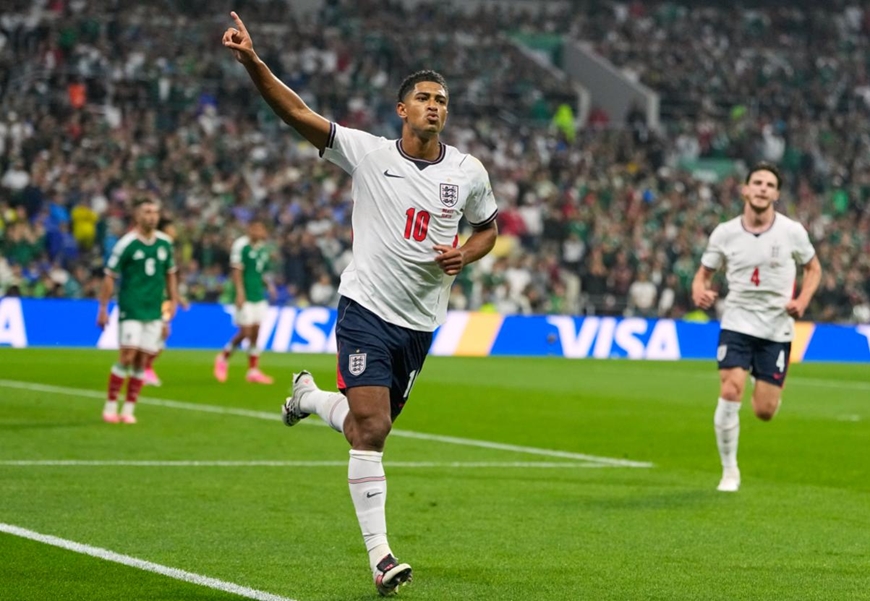
A loose ball dropped near the edge of the area. For a split second, defenders hesitated. Bellingham did not. He moved first, controlled the ball with calmness that seemed impossible under pressure, and struck with the confidence of a player who understood the weight of the moment.
The ball flew past the goalkeeper.
For half a second, the stadium froze.
Then came the explosion.
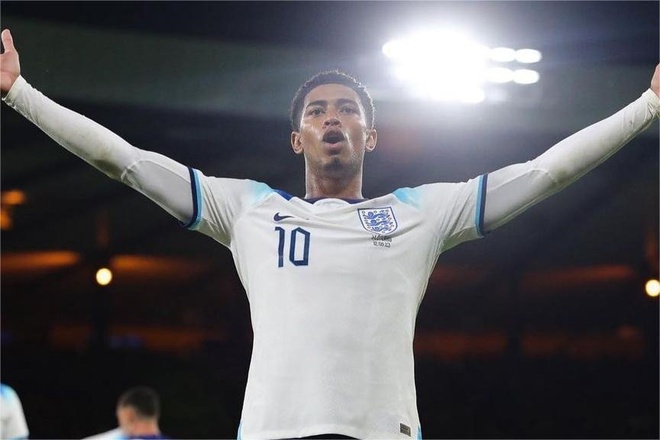
Eighty thousand people rose as one. Arms flew into the air. Strangers hugged each other. England players sprinted toward Bellingham as he spread his arms wide, chest out, eyes burning with emotion. The goal had broken the wall, but nobody expected what came next.
Before the noise had even fully settled, England attacked again.
This time, the move came faster. A quick pass through midfield. A run into space. A defender dragged out of position. Bellingham arrived at exactly the right place, exactly when England needed him most.
The finish was ruthless.
Two minutes after his first goal, Bellingham had scored again.
The stadium did not just celebrate. It erupted.
The sound was almost unreal — a wave of disbelief, joy, relief, and shock crashing together. Supporters who had spent most of the match fearing the worst were suddenly watching their team surge ahead through one of the most dramatic individual bursts in recent memory.
Bellingham had not simply scored a brace. He had turned a tense match into a moment of national release.
The scoreboard changed. The mood changed. England changed.
From that point, the team played with renewed energy. The passes became sharper. The pressing became more aggressive. The players moved like a side that had rediscovered its belief. Bellingham, meanwhile, seemed to be everywhere. He tracked back, fought for loose balls, demanded possession, and pushed his teammates forward.
It was not only a performance of skill. It was a performance of personality.
That is what made the night feel so powerful.
Bellingham did not hide from the pressure. He walked straight into it. When England needed someone to take responsibility, he accepted it. When the match became uncomfortable, he embraced the discomfort. When 80,000 fans were waiting for a hero, he gave them one.
But greatness often carries a cost that fans only see at the very end.
As the final minutes ticked away, England had to suffer. The opposition pushed forward, desperate to find a way back. Crosses came into the box. Clearances were celebrated like goals. Every whistle from the referee brought a reaction from the crowd. England’s players shouted, pointed, organized, and fought to protect what Bellingham had given them.
When the final whistle finally sounded, the stadium exploded again.
Players embraced. Fans screamed. Flags waved. On the sideline, staff members hugged each other. It was a victory built on tension, courage, and one unforgettable two-minute storm from England’s number 10.
But while others celebrated, Bellingham slowly sank to the ground.
At first, it looked like exhaustion. Then cameras moved closer.
He was crying.

Sitting on the grass, still in his England shirt, still wearing the dirt of the battle, Bellingham wiped his eyes as the emotion poured out. Teammates quickly noticed and came toward him. Some placed hands on his shoulders. Others stood nearby, allowing him the space to feel the moment.
It was not weakness. It was the opposite.
It was the release of pressure that few people can understand.
The pressure of carrying expectation. The pressure of being judged every time you touch the ball. The pressure of hearing the noise before the match, during the match, and after the match. The pressure of knowing that one chance can define a night.
For Bellingham, the tears seemed to say what words could not.
He had given everything.
Moments later, the official announcement confirmed what everyone inside the stadium already knew: Jude Bellingham had been named Man of the Match.
The decision required no debate.
Two goals in two minutes. A match-winning performance. A display of leadership beyond his years. A night where England looked for inspiration and found it in the player wearing number 10.
As he received the recognition, Bellingham still looked emotional. The cheers from the stands grew even louder. Fans chanted his name, not just because of the goals, but because they had seen the human side of a star often expected to be unbreakable.
That is what made the moment so memorable.
Football fans love winners. They love goals, trophies, records, and dramatic victories. But sometimes, what touches people most is not the celebration. It is the vulnerability after the victory. It is seeing a player who has just delivered greatness still feel the weight of it like any human being would.
Bellingham’s tears turned a brilliant performance into a deeply emotional story.
For England supporters, the night will be remembered for the brace. For the two minutes that changed everything. For the sound of 80,000 people losing their minds at once. For the way Bellingham stood with arms wide after scoring, then later sat on the same pitch with tears in his eyes.
From triumph to release. From pressure to glory. From silence to explosion.
This was not just another win.
It was a reminder that football can still create moments that feel bigger than sport.
And at the center of it all was Jude Bellingham — the star who scored twice, lifted England when they needed him most, won Man of the Match, and then cried like a player who knew exactly how much it all meant.
